Buying a yacht internationally can save money and provide access to a much wider range of cruising catamarans than buying locally.
This resource hub explains the process we followed purchasing a yacht in the South Pacific, from researching destinations and finding reputable brokers to arranging inspections, surveys, negotiations and international ownership transfer.
Drawing on real experience buying and preparing offshore cruising catamarans, we hope our ideas arm you with tactical ideas from practical issues that buyers often overlook, including import considerations, registration, insurance, delivery planning, refit costs and preparing a newly purchased yacht for offshore cruising.
Whether you're searching in Australia, New Zealand, Fiji, New Caledonia, Tahiti or other South Pacific destinations, this articles will help you reduce risk, avoid costly mistakes and make informed decisions before committing to an international yacht purchase.
Have to start somewhere!
Our IMPACT Method
(You serious)
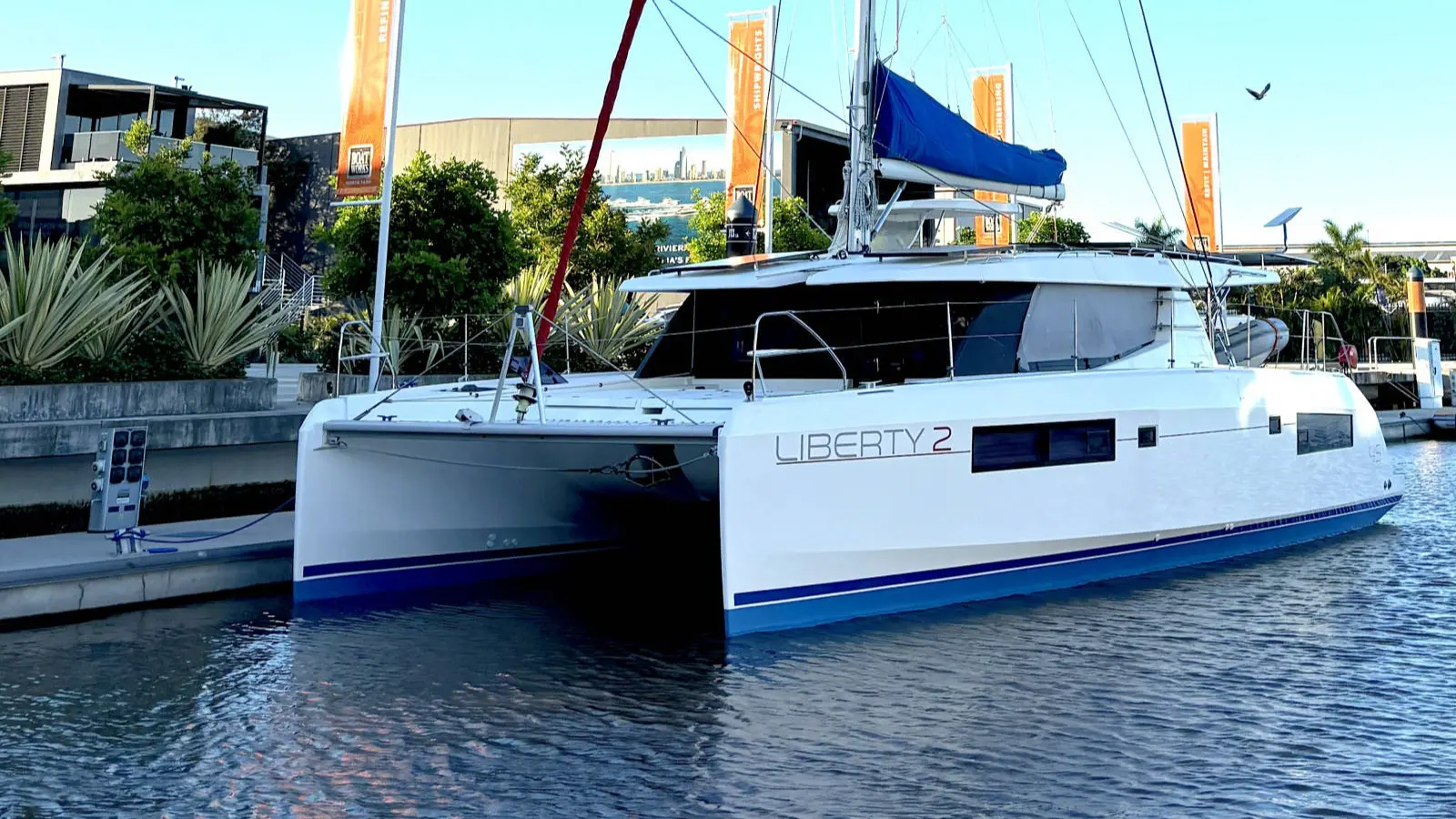
Built in South Africa, the Robertson and Caine Leopard 45 continues to attract cruising sailors looking for a capable, comfortable, and practical bluewater catamaran. While every owner has different priorities, there were several features that influenced our decision to buy a Leopard 45.
Forward Cockpit with Direct Saloon Access
One of the Leopard 45's defining features is its forward cockpit. Unlike traditional catamarans, the forward seating area connects directly to the saloon through a watertight door, creating a second outdoor living space with excellent ventilation and easy access to the foredeck.
Spacious Liveaboard Accommodation
Available in both three-cabin owner's and four-cabin layouts, the Leopard 45 offers generous living space. The owner's version dedicates an entire hull to a private suite, making it a popular choice for couples planning extended cruising or full-time liveaboard life.
Comfortable Offshore Performance
Designed by Simonis & Voogd, the Leopard 45 delivers predictable handling under sail and a comfortable motion at sea. At around 20 tonnes fully loaded, its weight works in our favour offshore, helping maintain momentum through swell and a more consistent speed than lighter vessels, which are often slowed by wave action. Its wide beam also provides excellent roll stability.
Deck Layout - very Practical
The wide beam provides generous side decks, offering nearly one metre of clear walkway on either side of the saloon and cockpit. Upper bridgedeck hatches are also flush mounted, reducing the trip hazard when offshore. Combined with chest-height handholds around the saloon and an elevated helm station, moving around the boat is simpler and safer, in our opinion.
Sail controls are positioned for short-handed sailing, allowing one or two people to handle the yacht with confidence. This was a mandatory requirement for us, as much of our sailing is done single-handed.
Excellent Storage Capacity
For those not used to a catamaran, we have a lot of storage normally when compared to a monohull. Already being spoilt with this, as a long-distance cruiser, we appreciate the Leopard 45's additional abundant storage, it really leaves many other production catamarans for dead. Large lockers, under-berth compartments, dedicated equipment spaces, and generous galley storage make it easier to carry provisions, spare parts, and cruising gear for extended voyages.
Bright and Functional Interior
Large panoramic windows fill the saloon with natural light while providing excellent visibility from inside the boat. The open-plan galley and saloon create a comfortable social space for entertaining or relaxing after a day under sail.
Proven Build Quality
Here's a tightened version with improved flow and grammar while keeping your first-hand experience and overall length.
The Leopard 45 has earned a reputation for solid construction and durable systems. It is one of the few 45-foot catamarans fitted with large aluminium crossbeams, a feature many other manufacturers omitted.
During our 2,000-nautical-mile passage home from Tahiti, we deliberately pushed the catamaran hard. This exposed any structural weaknesses while ironing out the performance issues every new owner encounters. We now confidently passage plan at 8 knots and prefer cruising in 15 to 25 knots of wind. With the right swell and favourable conditions, it is genuinely comfortable sailing around the clock.
While many criticise the height of the bridgedeck sides, we appreciate them. Their height reduces green water over the bow and keeps us considerably drier.
Another feature we value is the fixed keel with its sacrificial lower section. The draft is 1.6 m, which is deep for a catamaran. However, we rarely anchor in less than 5 metres of water, so it has never been a concern.
Resale Value
The Leopard 45 remains one of the most sought-after production cruising catamarans on the used market. High demand, a well-established owner community, and a reputation for offshore capability help maintain strong resale values compared with many competing models.
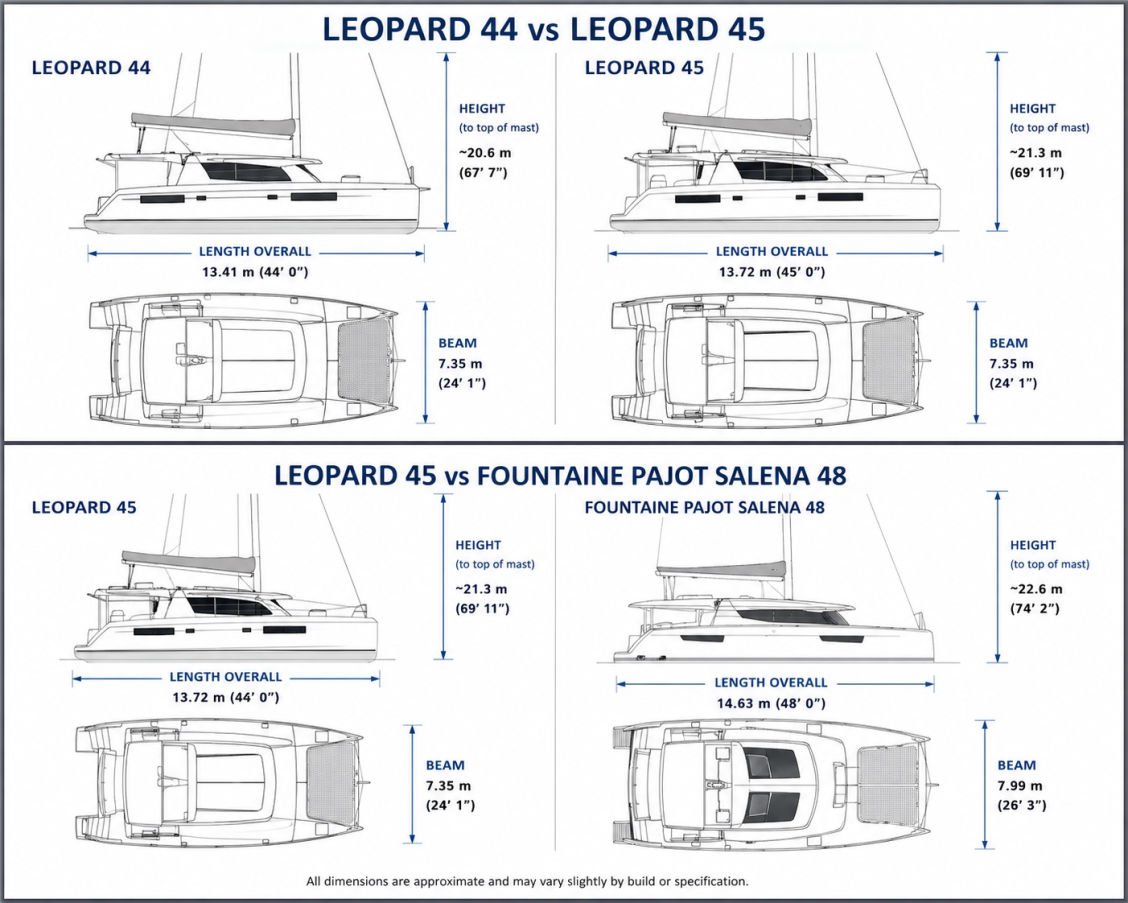
Leopard 44 vs 45, and Leopard 45 vs Fountaine Pajot Salina 48
Leopard 45 next to a Fountaine Pajot Salina 48 - higher sides of the 45.
Buying a catamaran internationally in the South Pacific
1. What is the target area?
Finding the right yacht in your own city can be difficult. Doing it in another country adds a whole new level of complexity. So how did we confidently make a safe, informed decision while searching across international markets?
Searching the global yacht market is not without challenges.
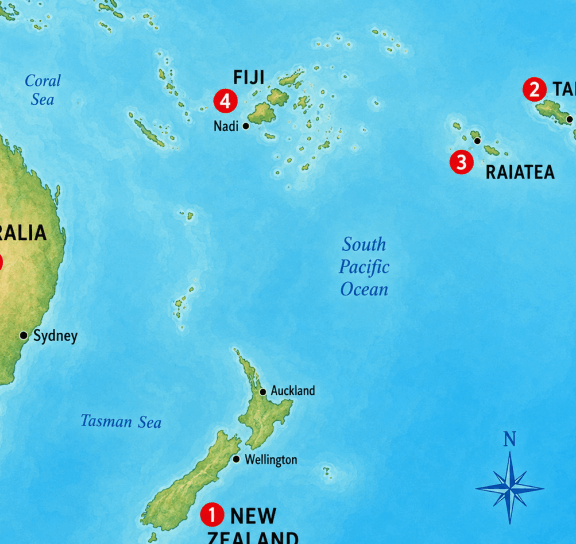
Although we could search worldwide, we narrowed our focus to the South Pacific because of time constraints and favourable sailing seasons. Our search was further narrowed to New Zealand, Tahiti, Raiatea, Fiji, New Caledonia and Australia, due to reliable chandler and haulout services these countries offered.
From dozens of yachts, five stood out as serious contenders:
1. New Zealand: Leopard 48 (2013)
2. Tahiti: Leopard 45 (2018)
3. Raiatea: Lagoon 45 (2015)
4. Fiji - Catana 45
5. Australia: Lagoon 45 (2015)
2. Be dead serious about buying
To prove we were serious buyers, we flew to inspect each yacht in person rather than taking the typical "tyre-kicker" approach.
New Zealand: We appraised a Leopard 48, ran the numbers, and submitted a contracted cash offer with a 48-hour acceptance period. When there was no movement, we withdrew and continued our search.
French Polynesia: In Raiatea, we inspected a Leopard 48 and compared it with a similar Lagoon 45 in Australia. The Australian yacht represented better value, so we did not proceed in Raiatea.
Tahiti: We inspected a Catana 45, similar to the one listed in Fiji. In our opinion, the living space on a catamaran of this size was too limited and not what we were looking for. We decided not to fly to Fiji to inspect the other Catana 45.
The Leopard 45 sat at the top end of our budget. Its remote location meant every calculation had to be accurate, as any mistake would have been expensive.
3. Do your homework (keep the answers close to your chest)
One advantage in the South Pacific is learning as much as you can about the seller.
Are they based in the Northern Hemisphere? How long has the yacht been on the market? How many brokers have they appointed? These questions matter to both you and the Seller.
All South Pacific countries place time limits on foreign-owned vessels before stamp duty or import taxes may apply. The alternative is relocating the yacht to another country, which can be expensive.
Most repositioning passages take 3 to 10 days, and sellers usually want to avoid them.
As the buyer, make sure you do not get caught by the same deadlines. If the yacht only has a few months remaining before local time limits expire, that may not be enough time to prepare the vessel and legally depart.
Understand the rules and use them to strengthen your negotiating position.
4. We applied our IMPACT METHOD to every offer
a. Submit a substantial cash (cheque) deposit with the offer.
b. Limit the response period to 48 hours.
c. Set the shortest practical settlement, allowing at least two weeks to deregister a foreign vessel before completion.
d. Arrive fully prepared with market research, clear numbers, and a fair offer.
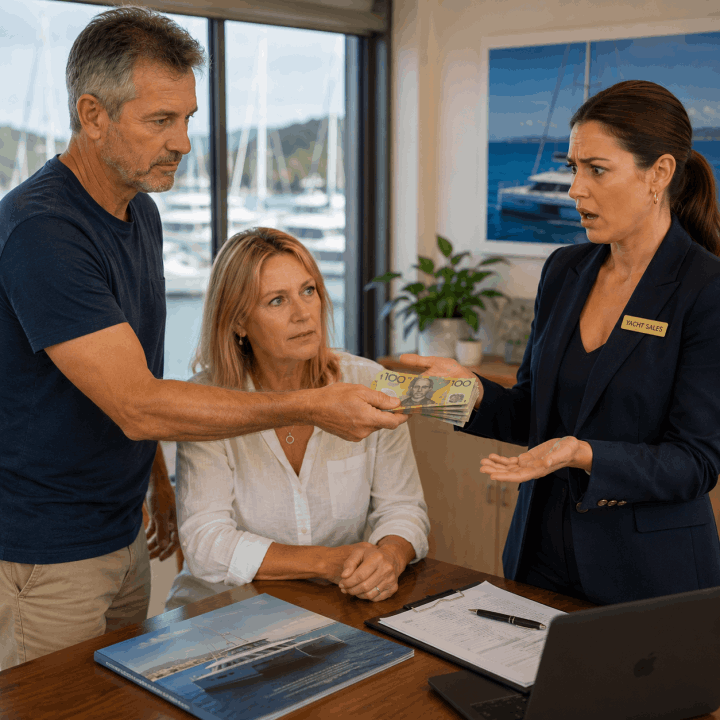
Before we even sat down, we handed the salesperson a substantial cash deposit. At that point, they had no idea what our offer would be. We then presented the completed purchasing documents.
Before they had time to respond, we clearly outlined our purchasing conditions and then revealed our non-negotiable final offer.

This is not the approach most salespeople expect. They can see a commission within reach, but they also know they have serious work to do and only 48 hours to make it happen.
If the deadline passes, the deal is off.
From that moment, you control the process. We made it clear we were dead serious about buying and were actively considering other yachts. They will almost certainly ask where and which ones. Keep that information to yourself. Never give them an opportunity to gain an advantage. We were there to buy a yacht, nothing else.
This disciplined approach quickly identified sellers who were genuinely ready to do business, allowing us to move efficiently through the competitive South Pacific yacht market.
6-rules to turning the tables and getting your way
1. Do your homework.
2. Find a salesman you can trust - yes...there are a few around.
3. COME IN WITH IMPACT - Hold your cards close to your chest, but don't tyre-kick.
4. Be dead serious about buying the vessel and do not let your heart ('I like it, it's pretty etc') rule your head.
5. Limit the sellers decision period. We use 48-hrs, then all bets are off...move on (i.e. if the seller is serious, they will come to the party).
6. Have factual numbers to back yourself. Don't be silly about the offer.
In the international yacht market, much of what you hear comes through word of mouth, and for good reason. Brokers are typically paid a commission by the Seller, not the buyer, which means the Buyer is often navigating the process independently.
So how did we turn this reality to your advantage?
First Impressions
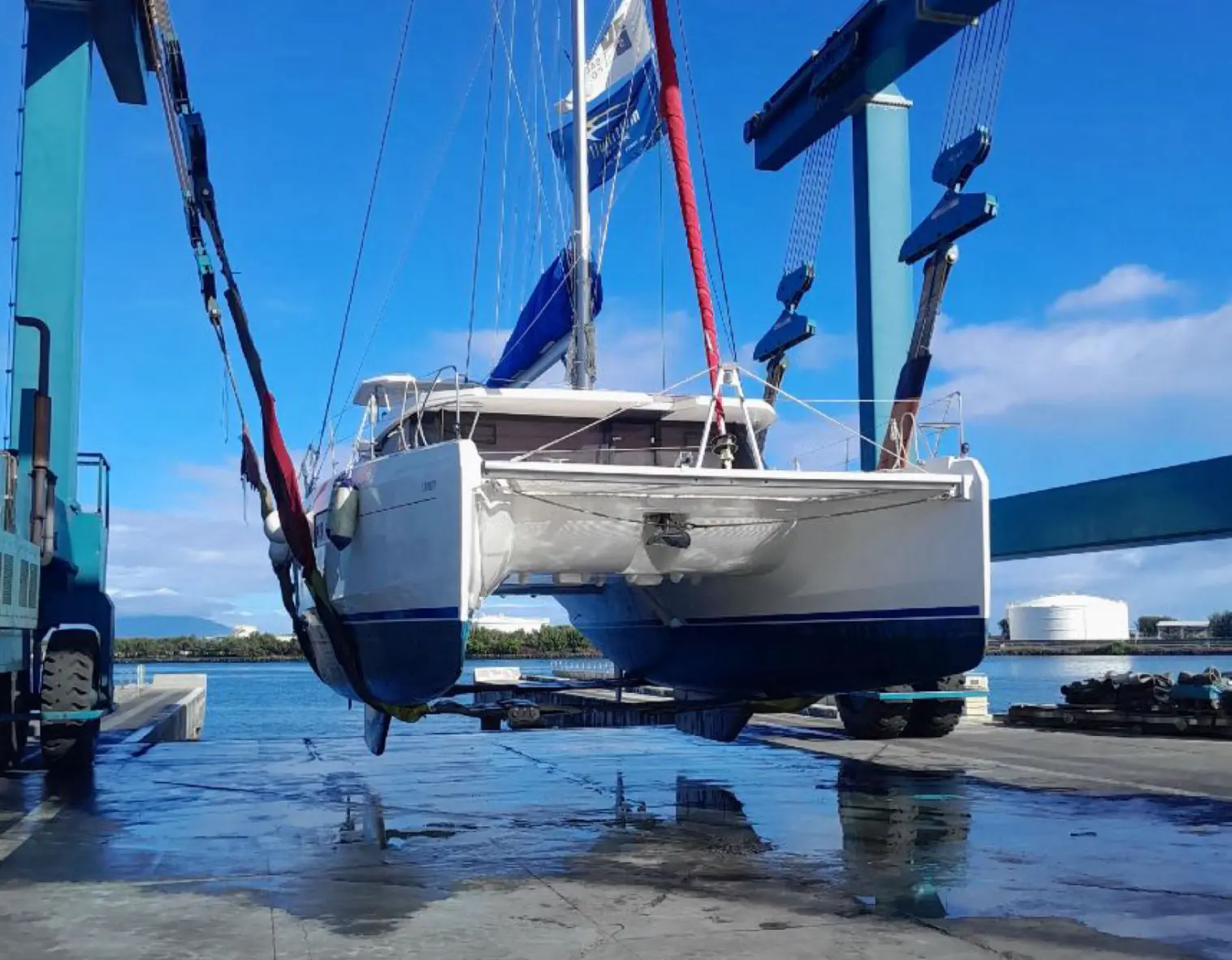
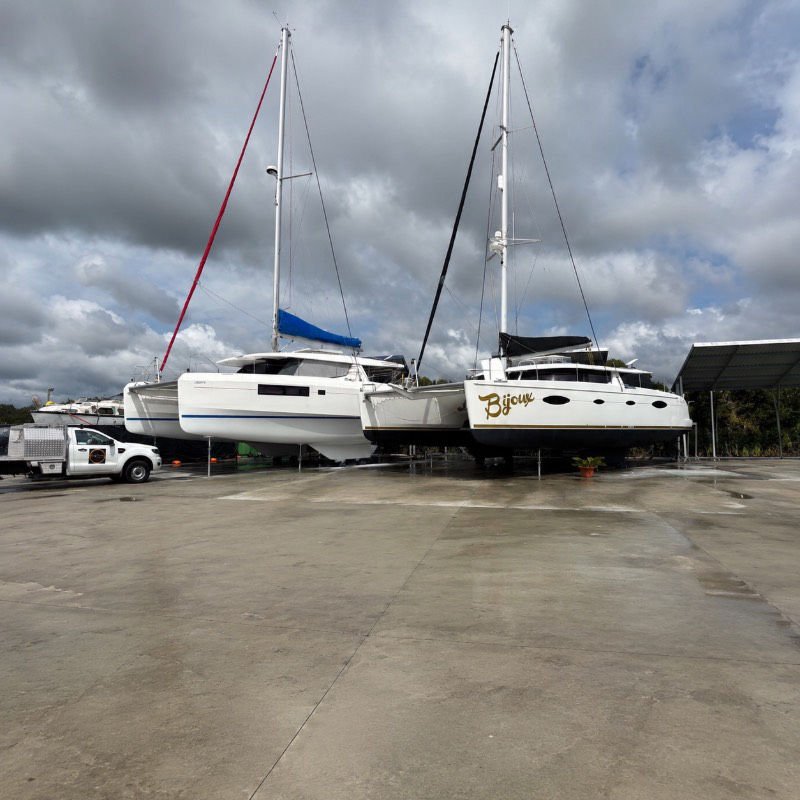
Over the past five years, one salesperson consistently stood out during our yacht haulouts at Boat Works, Coomera.
Each time this person made his rounds, he was approachable, knowledgeable, attentive, and always respectful of our space. His advice was simple: "If you need a trade, just ask. I'll find the right person."
A few years later, while searching online for our next yacht, his company kept appearing in our research, so we decided to get in touch. From the outset, we made it clear that we did not want constant phone calls, marketing emails, or mailing lists.
That salesperson was Brett Horner from The Yacht Sales Company on the Gold Coast.
Brett was exactly as we remembered: easy to deal with, knowledgeable, responsive, and respectful of our requirements. That professionalism and discretion gave us the confidence to work with him on our next purchase.
Through Brett, we were introduced to Gilles Haudrechy from The Yacht Sales Company in Tahiti. Gilles' direct communication was refreshing. Any issues were identified early, and once the purchase was underway, his local knowledge became invaluable.
After settlement, he helped source tradespeople, locate hard to find parts, and even drove us to the best chandlers before dropping us back at the yacht.
Managing foreign currency transfers and Australian registration could easily have become stressful, but the behind the scenes support from the The Yacht Sales Company team in Australia, particularly Christina, made the process straightforward.
Every yacht purchase is different, and experiences will vary. Ours was consistently positive, and we have no hesitation in acknowledging the professionalism and support we received from the The Yacht Sales Company team.
South Pacific Corals
At Boatworks, Australia.